Clearscope vs MarketMuse (2026): Which Content Tool Is Worth Paying For?
Clearscope grades the draft in front of you. MarketMuse decides what to write next across your whole site. Here is what each one really costs, where each one stops, and which one fits your team.
Quick answer: Buy Clearscope if writers need a grade to work toward on drafts they already own — Essentials is $129 a month with unlimited users, and it is the cleanest editor in the category. Buy MarketMuse if a strategist needs to decide what to create, refresh, or consolidate across a whole content library — its free tier gives you 10 queries a month to learn the interface, and paid tiers are quote-only. If your problem is that pages never ship, neither tool fixes it: both grade and advise, and neither publishes.
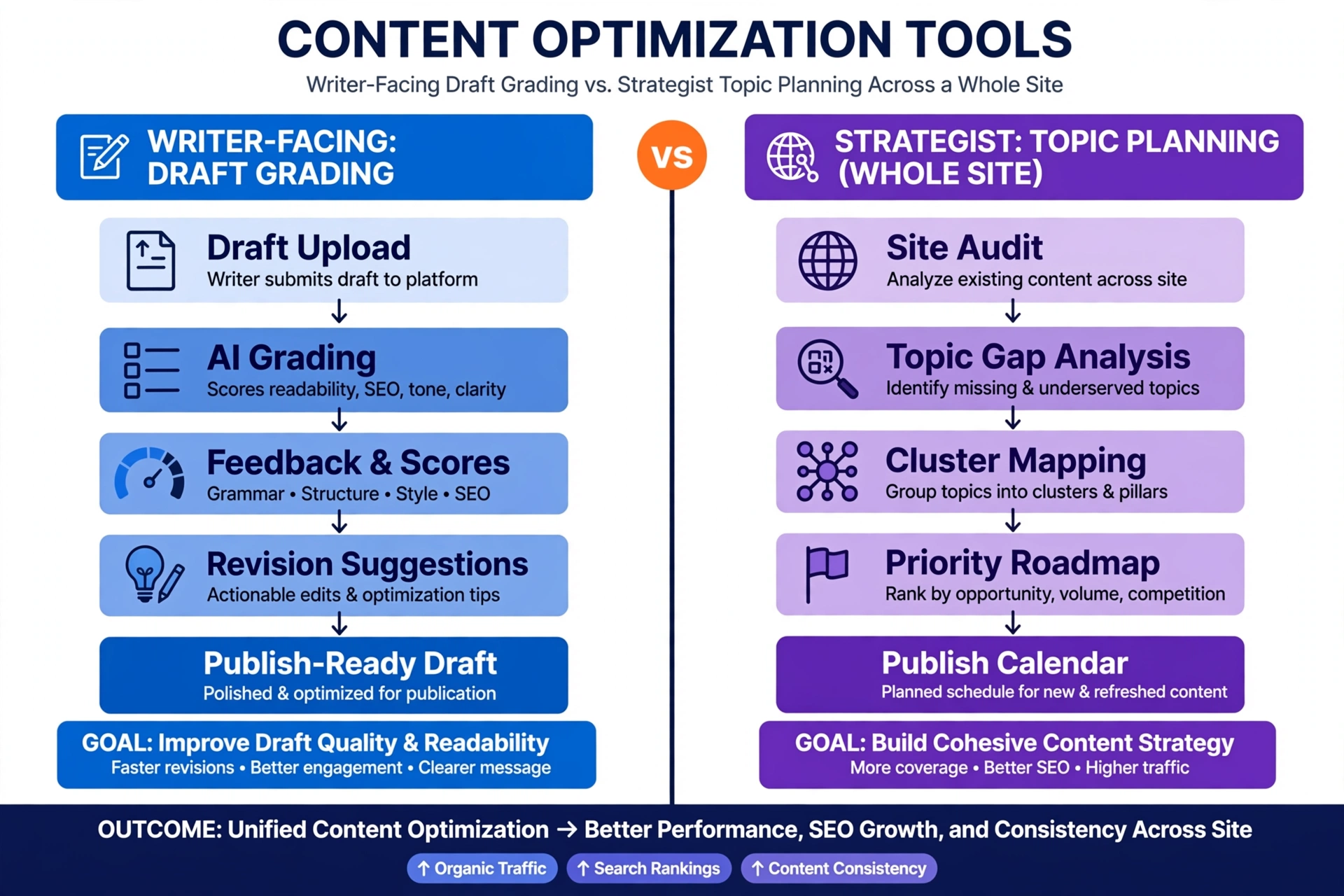
Clearscope and MarketMuse get lumped into the same category, and the comparison usually stops at “both optimize content.” That misses the actual decision. Clearscope is a writer-facing tool built around real-time grading of the page in front of you. MarketMuse is a strategist-facing platform built around topic models, a content inventory, and prioritization across your entire site. One improves drafts. The other decides which drafts are worth writing.
Clearscope vs MarketMuse at a Glance
Dimension
Clearscope
MarketMuse
Core job
Grade and optimize one draft in real time
Plan and prioritize a whole content library
Best for
Writer-centric teams, editors, freelancers
Strategists, SEOs, content ops
Entry price
$129/mo (Essentials)
Free (10 queries/mo); paid tiers quote-only
Seats
Unlimited users on every tier
Free: 1 user; paid tiers by seat
Brief depth
Term coverage, headings, length
Subtopics, intent, cluster context
Content inventory
Tracks pages you optimize
Full site-wide inventory with gaps
Internal linking
Manual only
Topic-based link recommendations
AI visibility tracking
Prompt + brand tracking (ChatGPT, Gemini)
Topic/inventory metrics; no equivalent prompt tracker
Writer adoption friction; value sits in higher tiers
What Each Tool Actually Does
Clearscope: the grade your writers work toward
Clearscope builds a topic model from the pages currently ranking for your target keyword, then grades your draft against those benchmarks. The grade reflects term coverage, content length, and readability against top-ranking content. While drafting, writers see a content grade, recommended terms with usage counts, heading suggestions, and competitor outlines in a clean side panel.
The experience feels like a normal writing environment, which is why writers adopt it fast. It plugs into Google Docs and WordPress, so the optimization happens where the writing already happens. The current product is sold as seven modules — Expand for prompt tracking, Discover for query discovery, Write for AI drafting, Optimize for the editor, Protect for analytics and monitoring, plus Localize and Linking — but Optimize, the grader, is still the reason most teams buy it.
MarketMuse: the map of what to write next
MarketMuse builds topic models by analyzing large sets of documents on a subject, then uses those models to identify topics, related concepts, user intent, and competitor coverage. Its Content Inventory maps topics to your pages so you can filter by authority, traffic potential, and content gaps. This is the planning layer Clearscope does not try to replicate.
Its differentiator is personalized metrics. Personalized Difficulty estimates how hard a topic is for your specific site, based on your existing coverage and authority, rather than a generic difficulty number. Topic Authority measures how authoritative your domain already is on a subject. Competitive Advantage highlights where you can win with less effort. In practice, MarketMuse is usually owned by an SEO or strategist who turns its output into briefs for writers — writers often never touch the platform directly.
Pricing: The Part Competitors Get Wrong
Clearscope: $129 and $399, and the 20-draft trap
Clearscope’s pricing page lists two public numbers and a third behind a sales call:
Every tier includes unlimited users, unlimited projects, and unlimited sharing, plus a 14-day free trial and no contract. Extra pages and drafts are sold as add-ons priced by tier.
Read the table again, because the trap is in the last column. Tracked queries and pages jump six times between Essentials and Business. Topic explorations more than double. Drafts stay at 20. Paying $270 more a month buys a bigger telescope, not more writing. If your team drafts more than 20 pieces a month, budget for add-on drafts before you commit — the draft counter is the one that runs out first, and it is the one that does not grow when you upgrade.
Older reviews still quote Essentials at $170, $189, or $199, and one at $270. Those figures describe packaging that is no longer on the site. Use $129 and $399.
MarketMuse: a free tier, then a quote
MarketMuse publishes plan shapes but no dollar figures for paid tiers. Every paid tier requires a demo or sales quote:
Tier
Price
What it meters
Free
$0
1 user, 10 queries/mo, no briefs, no strategy documents, no inventory
You will find dollar figures for these tiers floating around — $99, $149, $249, $399, $499. Treat every one of them as unverified. MarketMuse is now sold as MarketMuse by Siteimprove, and the older self-serve prices in aggregator posts do not match a demo-gated pricing page. The free tier is genuinely useful for one thing: learning whether you can tolerate the interface before you book a call. Ten queries a month will not run a content program.
When you do get a quote, ask four questions before comparing it to Clearscope: what counts as a query, what counts toward the tracked-topic cap, whether briefs are capped per month or per quarter, and whether the site inventory covers all your URLs or a capped subset. Those four answers decide whether the quote is comparable to Clearscope’s $129 or $399 — the headline number alone will not.
What It Costs at Real Publishing Volumes
List prices rarely reflect what you pay, because the two tools meter different things. Clearscope meters reports: roughly one report equals one optimized piece. A team publishing 10 pieces a month sits comfortably on Essentials. At 25 to 50 pieces, the 20-draft cap forces add-ons or a conversation about Business — and Business still caps drafts at 20, so the upgrade buys monitoring scale, not writing volume.
MarketMuse meters queries, pages in inventory, and domains. A small team researching many topics across a large site can hit higher tiers at modest publishing volume, because the inventory cap, not the article count, is the binding constraint. Map your real workflow against each tool’s caps before committing: count your pages, count your monthly briefs, and count how many topics you research per piece.
The Honest Limit: A Score Is Not a Ranking
Both tools score content, and both scores are vendor-specific guidance. That deserves a plain paragraph, because it is where buyers get burned.
A high Clearscope grade means your draft covers the terms and length that top-ranking pages cover. It does not mean your claims are true, your sources are real, or your page will outrank anyone. A grade is not a gate, either — nothing stops a writer publishing a low-scoring page, so quality depends on editorial discipline, the thing understaffed teams run out of first. Coverage is not accuracy: hitting every recommended term says nothing about whether a claim is correct or where it came from.
MarketMuse’s scores have the same boundary in a different shape. Personalized Difficulty and Topic Authority are genuinely useful prioritization signals, but they are models of your site’s coverage, not predictions of ranking. A topic your site “should” win can still lose to a competitor with stronger links, fresher data, or a better answer. Treat both tools’ numbers as a shared definition of done for a draft, not as evidence the draft will rank.
Who Should Buy Which
Choose Clearscope if your team is writer-centric and wants fast adoption with minimal training; your bottleneck is writers producing optimized on-page content quickly; you work with freelancers or external writers who live in Google Docs or WordPress; and you already handle keyword research and planning with separate tools.
Choose MarketMuse if you are a strategy-led team responsible for an entire content program, not single posts; you are building topical authority across a category and need site-wide prioritization; you manage hundreds or thousands of URLs and a large backlog; and you have a dedicated SEO or strategist to own the workspace and translate its output into briefs.
Buy neither yet if nobody on the team will open an editor this week. A better dashboard does not fix a shipping problem. Both tools hand you recommendations; the work of producing, approving, and publishing still falls on your team.
Where Surfer and Frase Sit
Surfer and Frase are the other pair buyers usually cross-shop here. In short: Frase is the cheaper research-to-publishing loop (briefs, drafting, optimization in one product, starting around $39–$49 a month), and Surfer is the volume optimizer (Content Editor plus audit and monitoring, sold as annual document pools). If your shortlist is Clearscope vs MarketMuse, do not let a third comparison hijack the decision — pick the workflow first, then the tool. The Surfer-vs-Frase decision is a different buy for a different team shape.
The Same-Article Test (Run It Yourself Before You Pay)
Neither this article nor any competitor’s ran the same real article through both tools, and you should not take any roundup’s word for how either one behaves on your content. Run this protocol instead. It takes one afternoon per tool, most of it watching the output.
Pick one real article from your site — one that ranks on page two or three, not your best page and not a new one. In Clearscope, run it as an Optimize report; in MarketMuse, run it as an Optimize query. Record: the grade or score each tool gives, the top five gaps each tool names, how many of those gaps are real problems versus term-stuffing suggestions, and how long it takes a writer to act on them. Then rewrite the article once, using only one tool’s guidance, and track clicks and impressions in Search Console for 60 days — separately from any other change. A tool whose gaps your writer rejects half of is not worth $129 a month, whatever its marketing says.
Frequently Asked Questions
Is Clearscope worth it?
For an editorial team optimizing pages it already owns, yes — mainly because every tier includes unlimited users and projects. A five-person team pays $129 flat, not five seat licences. It is not worth it if your bottleneck is pages not shipping, because the grade advises and never publishes.
Is MarketMuse worth it?
For a strategist managing a large content library, the inventory and prioritization can justify a quote-only price — but only if someone owns the workspace. For a solo blogger or a team optimizing a handful of pages a month, it is overkill: the free tier’s 10 queries will frustrate you, and the paid tiers are priced for programs, not posts.
How much does MarketMuse cost?
MarketMuse does not publish paid prices. The free tier is $0 with 1 user and 10 queries a month. Optimize, Research, and Strategy require a demo or sales quote. Any dollar figure you see quoted for those tiers is unverified — confirm it on your own quote.
Does Clearscope have a free plan?
No. It has a 14-day free trial with no contract. Load your real pages and queries on day one, because monitoring needs elapsed time to show you anything.
Can I use Clearscope and MarketMuse together?
Yes, and larger operations sometimes do: MarketMuse for prioritization and briefs, Clearscope for writer-facing grading. That only makes sense once each tool earns its own seat — start with the one that matches your bottleneck, not both.
The Bottom Line
If writers need a grade to work toward, buy Clearscope at $129 and watch the 20-draft cap. If a strategist needs to decide what to write next across a library, test MarketMuse’s free tier, then get a quote and interrogate what the caps meter. If nobody will open either tool on Monday, fix the shipping problem first — no grader ever published a page.
Prices verified: October 2026. MarketMuse paid prices are quote-only; figures circulating online are unverified.