

Perplexity vs ChatGPT: Which Is Better for Research?
Quick answer: For research, Perplexity wins — every query hits the live web and every claim carries an inline citation you can click through. For everything after research — drafting, analysis, coding, reasoning — ChatGPT wins. The honest power-user answer is the handoff: Perplexity gathers verified facts, ChatGPT thinks with them. Both flagship plans sit at ~$20/month, and the free tiers are generous enough to learn the workflow before paying.
Most comparisons get this one wrong from the start, because they treat Perplexity and ChatGPT as the same kind of tool. They aren’t. Perplexity is an AI search engine: every query hits the live web, and every claim carries a citation. ChatGPT is a general-purpose AI assistant that generates, reasons, codes, and creates, with web browsing bolted on as an optional mode.
So “which is better” is the wrong question, asked in the abstract. The useful version is “better at what?” When the job is research specifically (finding verifiable, current information you can trust), there is a clear winner. But knowing the full picture matters more than crowning one.
Affiliate disclosure: this comparison is independent. If we link to paid plans, we may earn a commission at no extra cost to you.
The Short Verdict
For research, Perplexity wins. Its whole design revolves around retrieval and attribution: live sources, inline numbered citations, publication dates, and follow-up questions that drill deeper. When we need a fact we can cite, Perplexity is the first tab we open.
For everything after research, ChatGPT wins. Drafting the report, analyzing data, writing code, brainstorming angles, untangling messy notes. Its broader reasoning and creation abilities take over where Perplexity stops.
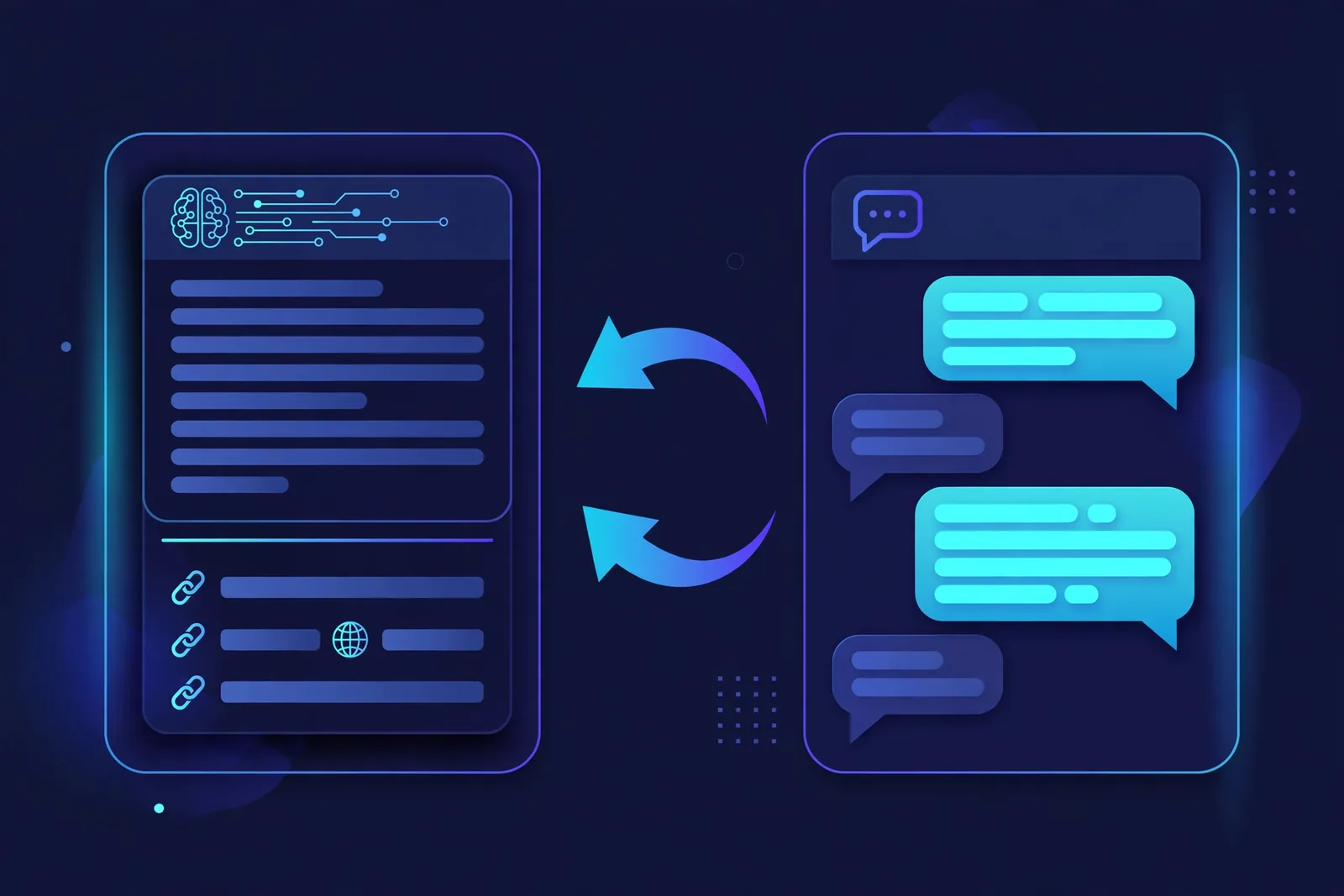
And the honest power-user answer is to use both. Perplexity gathers verified facts; ChatGPT thinks with them. That two-tool workflow beats either one alone, and we’ve been running it daily for months.
Perplexity vs ChatGPT for search: how do they compare head to head?
| Perplexity | ChatGPT | |
|---|---|---|
| Core design | AI search engine | General AI assistant |
| Citations | Inline, on every answer, by default | Inconsistent; browsing must trigger |
| Live web data | Always, it’s the default | Optional browse mode |
| Hallucination risk on facts | Lower (tied to real sources) | Higher (confident tone, invented details) |
| Deep research reports | Deep Research mode (capped monthly runs) | Deep Research (autonomous multi-step reports) |
| Writing and drafting | Serviceable, factual tone | Excellent, the stronger writer |
| Coding | Basic lookups only | Strong: generation, debugging, review |
| Image generation | Yes (Generate Image; free 3/day, unlimited on Pro) | Yes, built in |
| File analysis | Yes | Yes, stronger |
| Price | Free tier; Pro ~$20/month | Free tier; Plus ~$20/month |
| Biggest complaint (2026) | Tightening usage caps on Pro | Verbose defaults; citation reluctance |
Prices verified: October 2026.
Where does Perplexity win over ChatGPT?
Perplexity’s structural advantage is simple enough to state: it cannot answer without retrieving. Ask about a 2026 market statistic, a medical guideline, or a legal precedent, and you get an answer stitched from 6 to 12 live sources, each claim superscripted with a link you can click through to verify.
Three things other comparisons tend to underplay, all of which matter in real research work:
Publication dates surface automatically. Perplexity shows when its sources were published, which is a big deal for fast-moving topics. ChatGPT’s browse mode regularly presents last year’s data without flagging the staleness. This has burned us before. A confident-sounding 2024 stat inside a 2026 article is the kind of mistake that follows you around.
Follow-up questions stay sourced. Drill deeper with “what about the EU market?” and the citations keep coming. The thread turns into a research trail you can hand a colleague. Try the same thing in ChatGPT and the sourcing quietly evaporates by the third follow-up.
Spaces organize research. Perplexity’s Spaces let you scope searches to chosen sources. It is genuinely useful for competitive intelligence or literature reviews, anywhere you need to control the evidence base rather than trusting the open web.
The honest caveat: Perplexity is only as good as the pages it retrieves. If the top results on a niche topic are thin or slanted, its summary inherits those flaws. Verify high-stakes claims against the primary source, which is conveniently one click away.
Also worth knowing in 2026: Perplexity has tightened Pro usage caps more than once, and Deep Research allowances have reportedly shrunk. If you are a heavy researcher, test the free tier against your actual weekly volume before paying. Caps change; check the current limits on the pricing page.
Where does ChatGPT win over Perplexity?
Research rarely ends at “find the facts.” Someone has to turn those facts into an argument, a report, a strategy. That is ChatGPT’s territory, and it isn’t close.
Deep Research reports. ChatGPT’s autonomous research mode produces structured multi-source briefs that read closer to an analyst’s memo than a list of links. Better when you want the synthesis, not just the sources.
Drafting and rewriting. Turn findings into an executive summary, a blog section, or a client email. Perplexity’s writing is factual but flat; ChatGPT adapts tone and structure to the audience. This is the biggest practical gap between the two tools.
Data work. Upload a CSV of the stats you collected and ask for analysis, charts, or pivot-style breakdowns. ChatGPT is the stronger tool here by a clear margin.
Reasoning through ambiguity. “These two sources disagree. Which is more credible and why?” That is a judgment call, and ChatGPT’s reasoning models handle it better.
ChatGPT’s weakness is still what it always was: stated with total confidence, wrong with total confidence. Never cite a ChatGPT claim you haven’t verified somewhere else. That rule is exactly why the Perplexity-first workflow exists.

What’s the best workflow for using both tools?
After months of using both daily, here is the loop we actually recommend:
- Perplexity: “What does the current data say about X?” Collect the cited facts.
- Click through to 2 or 3 primary sources for anything you will publish or present.
- ChatGPT: paste the verified findings. “Synthesize these into a 500-word brief arguing Y.”
- ChatGPT again: “Now steelman the opposing view.”
You end up with Perplexity’s verifiability and ChatGPT’s thinking. Total cost: two free tiers, or $20/month for one Pro plan (both vendors price their flagship plan at ~$20/mo) if your volume demands it. We have written entire research-backed articles this way, and the quality difference against a single-tool workflow is obvious.
Which Should You Pay For?
Pay for Perplexity Pro if your job is finding accurate, current, verifiable information: journalists, analysts, researchers, students writing cited work.
Pay for ChatGPT Plus if you create more than you verify: writers, developers, founders, marketers. Anyone whose bottleneck is output, not sources.
Pay for neither yet if you are a casual user. Both free tiers are generous enough to learn the workflow. Upgrade when you hit limits twice in one week. That is the honest signal.
When We Still Open Google
For all our praise of AI search, here is an honest confession: we still open old-fashioned Google for certain things. Local business hours. Product reviews with real photos. Forum threads where actual humans argue about niche problems. Flight prices. AI search is brilliant for “explain this concept” and “summarize the research.” It is mediocre for “which plumber near me actually shows up.” Knowing which tool fits which question is the real skill.
The strongest researchers we know use all three: Perplexity for cited overviews, ChatGPT for working through ideas, Google for everything transactional and local.
Frequently Asked Questions
Is Perplexity better than ChatGPT?
For sourced research with citations, yes. For writing, coding, reasoning, and creative work, ChatGPT is better. They cover different halves of knowledge work.
Can Perplexity replace Google?
For direct questions, often yes. One cited answer beats ten blue links. For exploration, shopping, and local queries, traditional search still has its place.
Does ChatGPT browse the web like Perplexity?
It can, but browsing is an optional mode that doesn’t always trigger, and its citations are inconsistent. Sometimes accurate, sometimes fabricated. Don’t rely on it for cited work.
Is Perplexity free?
Yes, with a generous free tier. Pro (~$20/month) adds more Pro searches, file uploads, and Deep Research runs, though caps have tightened, so check the current limits on the pricing page before subscribing.
Which is better for students?
Perplexity for cited research papers (your professors will appreciate real sources); ChatGPT for understanding concepts, drafting, and studying. Use both.
Can I use Perplexity and ChatGPT together?
Absolutely. That is the recommended workflow: Perplexity gathers verified facts, ChatGPT synthesizes them.
Conclusion
The framing that works is not “which AI is better” but “which job am I doing right now.” Gathering verifiable facts? Perplexity. Thinking, writing, building with those facts? ChatGPT. The researchers thriving in 2026 aren’t loyal to one tool; they are fluent in the handoff between them.
In our experience, the biggest unlock is not choosing the right tool but trusting the workflow enough to build a habit around it. We keep both open in adjacent tabs most workdays, and the Perplexity-then-ChatGPT loop has quietly become the most productive hour of our mornings. Try it for a week before you pay for anything.
If you’re new to AI-assisted research, start with our guide on writing effective AI prompts. The quality of your questions determines the quality of both tools’ answers. And if you want the full picture on Perplexity itself, read our Perplexity AI review.
Keep reading:
– ChatGPT Review
– How to Write Effective AI Prompts
– How to Summarize PDFs with AI