

Quick answer: Suno‘s free tier (~10 songs a day) is the best free option for complete songs with vocals — but it’s create-only, with essentially no downloads and no commercial rights on free. Udio produces higher-fidelity audio, but since October 2025 it has disabled downloads on every plan, so Suno is the only one you can actually publish from right now. The golden rule: create for free all you want, but check the license before you monetize.
Why Free AI Music Generators Are Suddenly Good
Two years ago, AI music sounded like a robot gargling. Today, the free tiers of the best generators produce tracks you could actually play on a YouTube video without embarrassment. We’ve tested all the major ones, from full-song generators with vocals to background music engines built for content creators.
There’s one catch you need to understand upfront, and most “best free AI music” articles bury it: free almost never means commercial rights. You can make tracks for free, but using them in monetized videos or selling them usually requires a paid plan. We flag the commercial status of every tool below so you don’t learn this the hard way.
The 7 tools at a glance:
| Tool | Free tier | Commercial use on free |
|---|---|---|
| Suno | ~50 credits/day (~10 songs), create-only | No |
| Udio | 10 credits/day + 100/month, in-app only | N/A (no exports on any plan since Oct 2025) |
| BandLab | Fully free, no meaningful limits | Yes |
| Soundraw | Generate free, pay per download | No |
| AIVA | 3 downloads/month, attribution required | No |
| Mubert | Limited trial | No |
| Boomy | Create songs, no downloads | Limited |
Prices verified: October 2026.
1. Suno: The Best Overall Free Tier
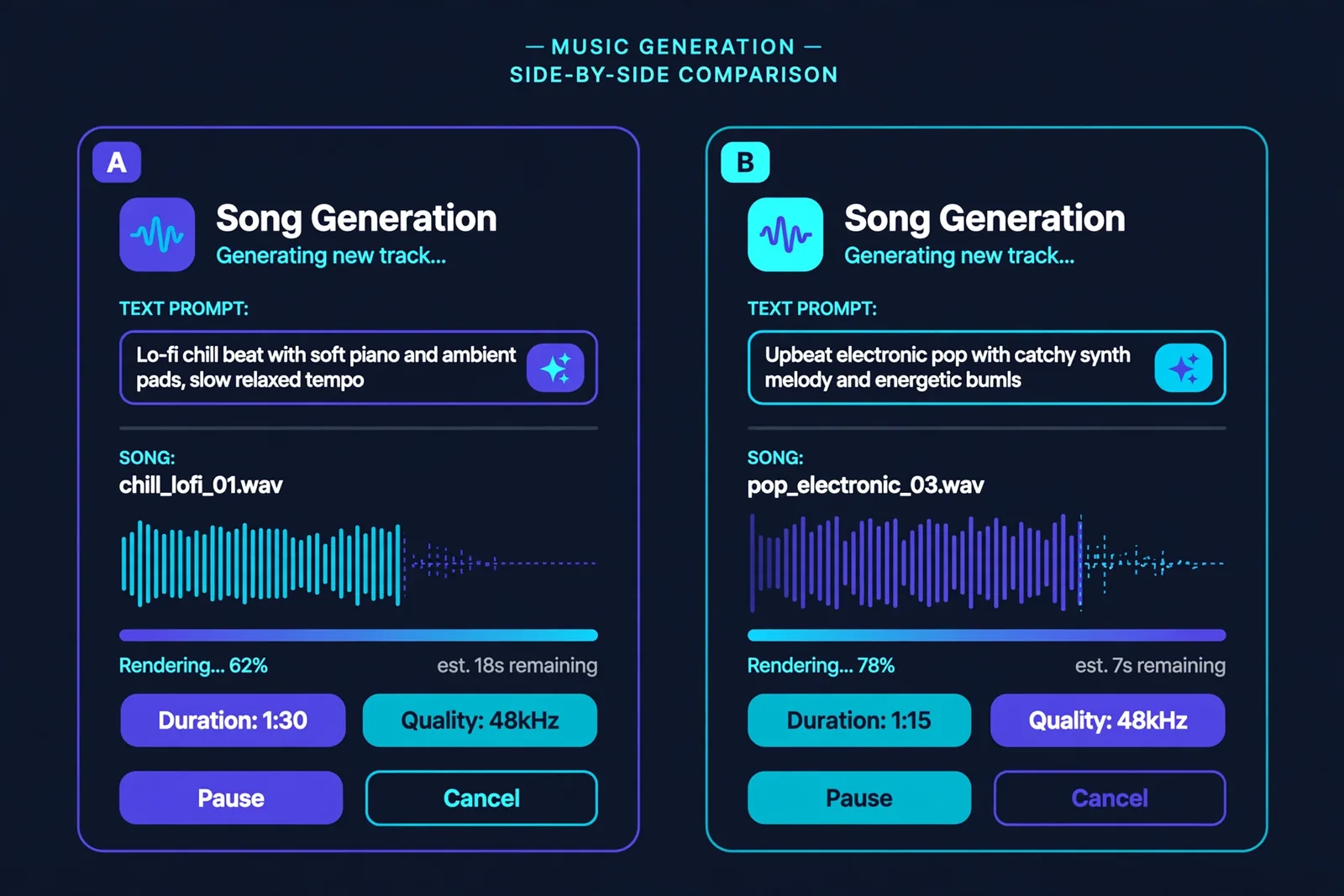
Suno remains the king of AI music generation, and its free tier is genuinely generous. You get around 50 credits daily, which works out to roughly 10 song generations per day. Each generation produces a complete song: vocals, lyrics, verses, chorus, bridges, the whole structure, in under a minute.
What impressed us most in testing was the structural intelligence. Give it a one-sentence prompt like “upbeat synth-pop song about summer road trips” and it doesn’t just loop a texture. It composes. Verses build, choruses land, bridges surprise. The vocal quality on the current v6 model is expressive enough to pass on casual listening.
One correction to what older guides say: the free tier is for creating, not for exporting. Free accounts get only a handful of lifetime downloads, so if you want to take tracks out of Suno, you need a paid plan. Paid plans start at $10/month ($8/month on annual billing) and unlock commercial rights plus 20 downloads a month.
Best for: Complete songs with vocals, YouTube intros, personal projects.
Free tier: ~50 credits/day, ~10 songs. Create-only; essentially no downloads.
Commercial use on free: No.
2. Udio: The Fidelity Champion
Udio was built by former DeepMind researchers, and you can hear the difference. Where Suno goes for reliable catchiness, Udio chases audio fidelity and structural ambition. In our tests, Udio handled genre-bending prompts, things like “Japanese folk fused with acid jazz,” with a musical intelligence that genuinely surprised us.
The free tier gives you 10 credits a day plus 100 a month, enough to experiment seriously but not enough for heavy production. The current model captures dynamic range and vocal nuance better than any other cloud tool we’ve tested. Jazz scats, opera holds, whispered verses, Udio renders them all convincingly.
Now the caveat, and it’s a big one: Udio disabled downloads on every plan in October 2025, during its licensing negotiations with the major labels. You can generate, remix, and iterate inside Udio, but you can’t export the file. That makes the Standard plan ($10/month, 2,400 credits) a hard sell for anyone who needs actual audio files. Udio is worth watching if downloads return, but until they do, treat it as an experimentation sandbox, not a production tool.
Best for: High-fidelity audio experiments, complex genres, vocal realism.
Free tier: 10 credits/day + 100/month. In-app only.
Commercial use on free: N/A, since nothing can be exported right now.
3. BandLab: Completely Free, Actually Free
BandLab is the odd one out here because it isn’t really an AI music generator in the Suno sense. It’s a full collaborative music studio, a DAW in your browser, with AI features layered in. And it’s completely free. No credits, no tiers, no catch.
The AI bits include SongStarter (generates musical ideas from prompts), AI mastering, and various assistive tools. You won’t get a finished vocal track from a sentence the way Suno does it, but you get unlimited creative tools and a real editing environment.
For creators who want to actually produce music rather than just generate it, BandLab is unmatched at the price of zero dollars. The community features, collaboration tools, and publishing options make it a legitimate music-making platform.
Best for: Real music production, collaboration, unlimited free use.
Free tier: Fully free, no limits that matter.
Commercial use on free: Yes, you own what you make.
4. Soundraw: Unlimited Generation, Pay to Download
Soundraw takes a different approach: generate as much as you want for free, pay only when you want to download. For background music, this is a brilliant model. You can audition dozens of tracks for your video, find the perfect one, and then pay for just that download.
The music itself is instrumental, mood-based, and designed for content creators. Pick a mood, genre, length, and intensity, and Soundraw generates royalty-free tracks to match. The quality is solid for background use, not something you’d release as a single, but perfect under a voiceover.
The Creator plan is $16.99/month (about $11/month on annual billing) and includes unlimited downloads with commercial licensing. If you need a steady stream of background music for videos, this is one of the best values in the space.
Best for: YouTube background music, podcasts, video creators.
Free tier: Generate and audition; downloads require a paid plan.
Commercial use on free: No (downloads require paid plan).
5. AIVA: For Cinematic and Classical Scores
AIVA specializes in what the others don’t: classical, cinematic, and orchestral composition. If you need a string quartet for a short film or an epic orchestral swell for a game trailer, AIVA is purpose-built for exactly that.
The free plan lets you create unlimited tracks but limits you to 3 downloads per month, non-commercial, with AIVA attribution required. The composition quality is genuinely impressive for the genre. It understands orchestration, dynamics, and arrangement in a way the pop-focused generators don’t.
Paid plans start with Standard (about €11/month on annual billing, roughly $12.50, or around €15 month-to-month; AIVA prices in euros) and unlock more downloads and platform-limited commercial rights.
Best for: Film scores, game music, classical composition.
Free tier: 3 downloads/month, non-commercial, attribution required.
Commercial use on free: No.
6. Mubert: Royalty-Free Backgrounds by the Hour
Mubert generates ambient and background music in real time, and its licensing model is one of the cleanest in the business. Paid plans offer flat-subscription commercial licensing with no per-track fees, which matters if you publish a lot of content.
The free tier is limited, more of a trial than a usable plan, but it’s worth mentioning because Mubert’s approach to generative music is unique. Instead of fixed tracks, it creates adaptive streams that can run indefinitely. For livestreams, apps, or long videos, that’s a killer feature.
Plans start at $14/month (Creator). One honest note: Mubert’s own pages are a little murky about what Creator covers commercially, so if your channel is monetized, the Pro plan at $39/month is the clearer choice for commercial rights.
Best for: Livestreams, apps, ambient background music.
Free tier: Limited trial.
Commercial use on free: No.
7. Boomy: Songs in Under a Minute
Boomy is the fastest path from “I want a song” to “I have a song.” Pick a style, tap a button, and you’ve got a track in under a minute. It’s dead simple, which makes it great for casual creators and kids, less great for anyone with specific artistic vision.
The free plan lets you create songs but not download them, which is a significant limitation. You can share them on Boomy’s platform, but taking your music elsewhere requires paying. There’s a revenue-share model where Boomy distributes your songs to streaming platforms and splits the earnings.
Best for: Quick song drafts, casual music making, beginners.
Free tier: Create songs, no downloads.
Commercial use on free: Limited.
The Commercial Rights Problem (Read This)
Here is the general rule across every tool we tested: free tiers let you create and experiment. Commercial rights, the legal ability to use tracks in monetized videos, ads, or products you sell, live behind paid plans. The cheapest verified commercial license we found was Suno Pro at $8/month on annual billing.
There are exceptions. BandLab gives you full rights to what you create because you’re actually making the music. Some tools’ terms shift over time, so always check the current terms of service before using any track commercially. AI music copyright is still legally unsettled territory, and the safest practice is a paid plan with explicit commercial terms.
How to Pick the Right One
For YouTube background music: Start with Soundraw’s free generation to find your sound, then subscribe for downloads and licensing. Suno’s Pro plan also works for monetized channels.
For full songs with vocals: Suno’s free tier is the most generous for experimenting; Suno Pro is the only serious option for publishing right now, since Udio can’t export.
For filmmaking or games: AIVA’s free tier gives you 3 cinematic downloads a month. Enough to score a short project.
For actual music production: BandLab. Free, unlimited, and you own everything.
For livestreams: Mubert’s generative streams are built for exactly this.
Frequently Asked Questions
Is there a completely free AI music generator?
BandLab is completely free with no meaningful limits, though it’s a music studio with AI features rather than a pure text-to-song generator. Suno’s free tier (50 credits/day) is the most generous pure generator. Truly free with commercial rights is rare; always check terms.
Can I use free AI music on monetized YouTube videos?
Usually not. Most free tiers grant personal, non-commercial use only. Using free-tier tracks on monetized content violates the terms of most platforms. Upgrade to a paid plan for commercial rights, or use BandLab where you own what you create.
What’s the difference between Suno and Udio?
Suno is better for reliable, catchy complete songs across many styles, with a more generous free tier, and crucially, it lets you download your tracks on paid plans. Udio produces higher-fidelity audio and handles complex, unusual genres well, but since October 2025 it has disabled downloads on every plan, so you can’t take anything out of it. Many creators used both; right now, Suno is the only one you can publish from.
Do I own the copyright to AI-generated music?
AI music copyright is legally unsettled. Platforms grant you usage rights through their terms of service (usually on paid plans), but the underlying copyright question hasn’t been definitively resolved in most jurisdictions. Avoid generating music that closely mimics specific artists.
Which free AI music generator has the best vocals?
Suno’s current model produces the most consistent, expressive vocals you can actually use. Udio edges it on raw vocal realism and fidelity, especially for emotional or acoustic material, but you can’t export Udio’s output right now. Both are dramatically better than anything available two years ago.
Can AI music generators make instrumentals without vocals?
Yes. Soundraw, Mubert, and AIVA specialize in instrumental music. Suno and Udio can also generate instrumentals if you specify “instrumental” in your prompt.
Conclusion
Open Suno today and generate your first ten songs — that’s the whole free daily allowance, and it’s the fastest way to learn what the tool can and can’t do. Save anything you like, then read the license terms before a single track goes near a monetized upload. When you’re ready to publish seriously, the $8–10/month tiers are waiting, and you’ll know exactly which one you need because you’ll have spent weeks on the free tier first.